

City Guide · 12 min read
Affordable public university tuitionResearch opportunitiesPublic transitCulture and historyAccess to the EUFrench immersion
Paris is France’s capital and one of the most requested destinations in the world for international students, home to the Sorbonne, Sciences Po, and a dense concentration of research institutions across the city. It combines a distinctively low-fee public university system, a full year to search for work after graduation for eligible graduates, and one of the world’s great cultural capitals as the backdrop to daily student life. The trade-offs are real too: most Bachelor’s programmes are still taught in French, and Paris’s student housing market is tight.

Country Context: France
- Student Visa: Requires a long-stay student visa (VLS-TS “Etudiant”), validated online within three months of arrival, which then functions as your residence permit for the length of the visa.
- Post-Study Work Rights: The APS permit (now formally “RÉCE”) gives eligible master’s, engineering, or PhD graduates of French institutions 12 months to work full-time while seeking a job, available to students from countries with a relevant bilateral agreement with France.
- Primary Language: French. Most Bachelor’s programmes are taught in French, though a growing number of English-taught Master’s programmes exist, particularly at Sciences Po and other grande écoles.
- Healthcare System: Once registered at a French university, students are generally covered under France’s national student health insurance scheme, one of the more automatically comprehensive systems of any major study destination.
Key Takeaways
- Public university tuition in France runs a genuine fraction of comparable programmes elsewhere, a distinctive feature of the French system, not just Paris specifically.
- The APS post-study permit is a real, usable 12 months, but eligibility depends on your degree level and your country’s bilateral agreement with France.
- Real French ability, not just admission, determines how workable most Bachelor’s-level daily academic life is.
- Healthcare here is simpler than several other destinations, most students are automatically covered once enrolled.
Education
Excellent
Home to some of the most prestigious universities and grandes écoles in Europe, with a distinctively low-cost public university system that keeps quality and affordability from trading off the way they do elsewhere.
Cost of Living
Mixed
Cheaper than London for most day-to-day expenses, but still a expensive European capital overall, particularly once housing is factored in.
Housing
Significant Challenges
A tight, competitive rental market with small units and high demand near central universities, though the CROUS public student housing system helps some students meaningfully.
Transportation
Excellent
The Metro, RER, and bus network together form one of the most extensive, affordable urban transit systems in the world, reaching nearly every part of the city and its suburbs.
Safety
Good
Generally safe for students taking normal city precautions, though pickpocketing around major tourist sites and transit hubs is a real, common concern.
Healthcare
Excellent
Automatic coverage under France’s student health insurance scheme once enrolled, backed by a healthcare system consistently rated among the best in the world.
Employment & Work Opportunities
Good
Real opportunities in finance, luxury goods, and a growing tech scene, though strong French ability meaningfully widens the realistic range of roles available.
Student Lifestyle
Excellent
An unmatched concentration of culture, history, and academic life in one city, with a large, international student population across its many institutions.
Climate
Good
Mild, temperate weather with warm summers and cool, wet winters, without the extremes of either a harsh winter or an intense summer.
Student Essentials
Monthly Budget
- Accommodation (shared/dorm)€750
- Food€320
- Transit Pass€40
- Phone & Internet€25
- Entertainment€160
- Total€1,295
Working While Studying
- Hours Allowed: Up to 964 hours per year (roughly 20 hours per week on average) for student visa holders.
- Common Jobs: Tutoring, hospitality, retail, and internships arranged through university career services, often tied to your field of study.
- Tax Notes: You’ll need a French social security number to work legally, and any local income is subject to standard French income tax rules above the relevant threshold.
Scholarships
Application Routes Worth Knowing
- Eiffel Excellence Scholarship: A French government-funded award for Master’s and PhD candidates at partner institutions, covering a monthly stipend and applied for through your host university, not directly.
- University-Specific Scholarships: Most major Paris institutions, including Sciences Po, run their own need- and merit-based awards, generally applied for alongside or shortly after admission.
- CROUS Housing and Meal Support: Not a scholarship in the traditional sense, but a valuable subsidy on student housing and campus meals that meaningfully lowers the real cost of studying in Paris.
Visa Requirements
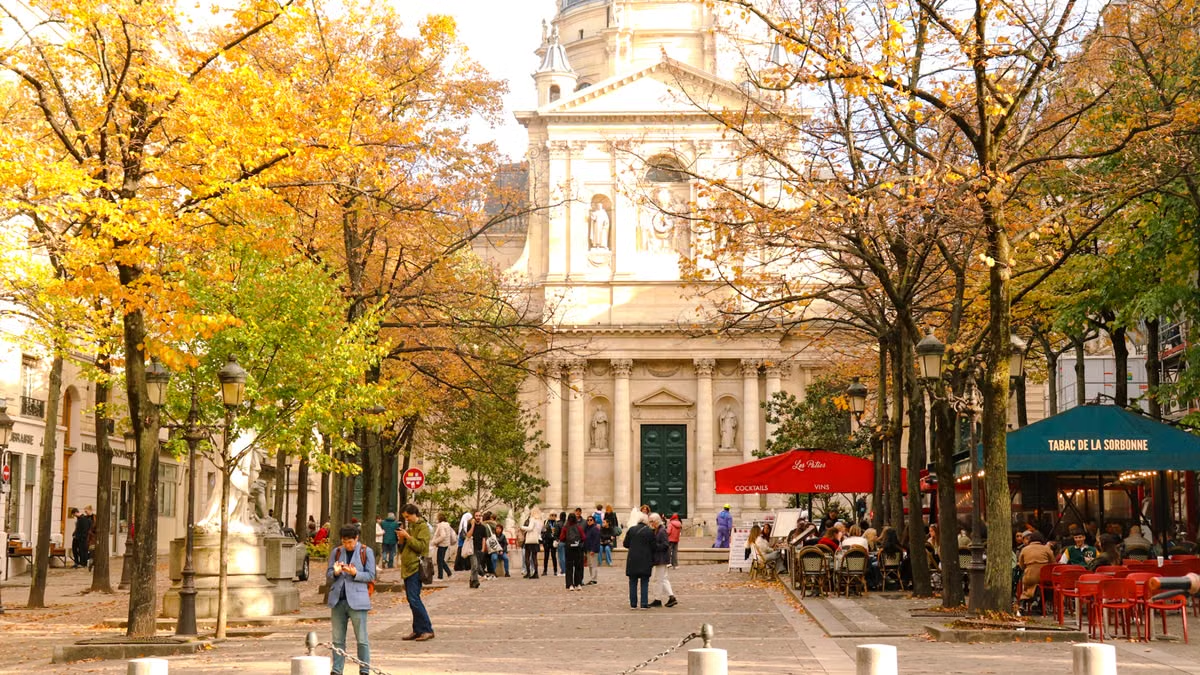
Sorbonne Universite
One of France’s most historic and internationally recognised public universities, with Bachelor’s registration fees of just €178/year for 2025-26, and a partial fee exemption for non-EU students, a distinctive feature of the French public system.
- Sciences
- Humanities
- Medicine
- Engineering
Sciences Po
One of the most selective and internationally recognised social science institutions in Europe, with tuition calculated on a sliding scale based on family income rather than a flat rate.
- Political Science
- Economics
- International Relations
- Law
PSL (Paris Sciences & Lettres)
A university alliance bringing together several of France’s most prestigious research institutions and grandes écoles under one umbrella, known for exceptional depth in the sciences and humanities alike.
- Sciences
- Engineering
- Humanities
- Arts

Also in this pillar
University Halls vs Private Renting for Your First Year Abroad
Neighbourhoods to Consider While Studying in Paris
There’s no single right answer here, so we’ve picked four areas that each do one thing particularly well. Whichever priority matters most to you, cost, lifestyle, space, or commute time, one of these should fit.
Latin Quarter
Best for Shortest Commute
The historic university district surrounding the Sorbonne, walkable to several major institutions, with rent running high given the location and constant demand.
Belleville
Best for Budget-Conscious Students
A diverse, lively northeastern neighbourhood with rent noticeably below the central arrondissements, connected to the city centre by several metro lines.
Le Marais
Best for Social & Cultural Life
A historic, walkable district with a strong arts, cafe, and nightlife scene, popular with students who want city life alongside their studies, at a real rent premium.
Vincennes
Best for Grad Students Wanting Space
Just outside the city proper, bordering the Bois de Vincennes park, with noticeably more space for the money and a direct metro line into central Paris.
How We Score This
Each category is rated on a five-point scale: Excellent, Very Good, Good, Mixed, or Significant Challenges. We use qualitative bands, and no decimal scores, because factors like student lifestyle or housing quality don’t reduce to a single comparable number from any one source. Ratings reflect research across publicly available information, and specific facts such as tuition figures and visa timelines are cited directly where they’re used.
Overall Student Experience Score
Very Good
An outstanding option for students prioritising affordability at public universities and genuine cultural depth, backed by excellent transit and healthcare. The main trade-offs to plan around are French language ability and the housing search, not cost or academic quality.
Where to Go From Here
-

The Student’s Guide to London
World-leading universities, a global city, and a cost of living that catches almost every international student off guard. Here’s what…
-

The Student’s Guide to Beijing
Two of the highest-ranked universities in Asia, remarkably affordable tuition, and a deep immersion in Mandarin. Here’s what studying in…
-

Banking Abroad as a Student: What to Sort Before You Go
Opening a bank account abroad often takes longer than students expect, and the gap is where problems start. Here is…
-

The Complete Guide to Settling Into a City Abroad
Arriving is the easy part. This is the guide to the months that follow, from the paperwork of the first…
-

The Student’s Guide to Tokyo
Internationally ranked universities, unusually affordable tuition, and one of the best transit systems in the world. Here’s what studying in…
-

How Do I Handle Culture Shock When I Move Abroad?
Culture shock is not a sign you made the wrong choice; it is the normal arc of moving your whole…