
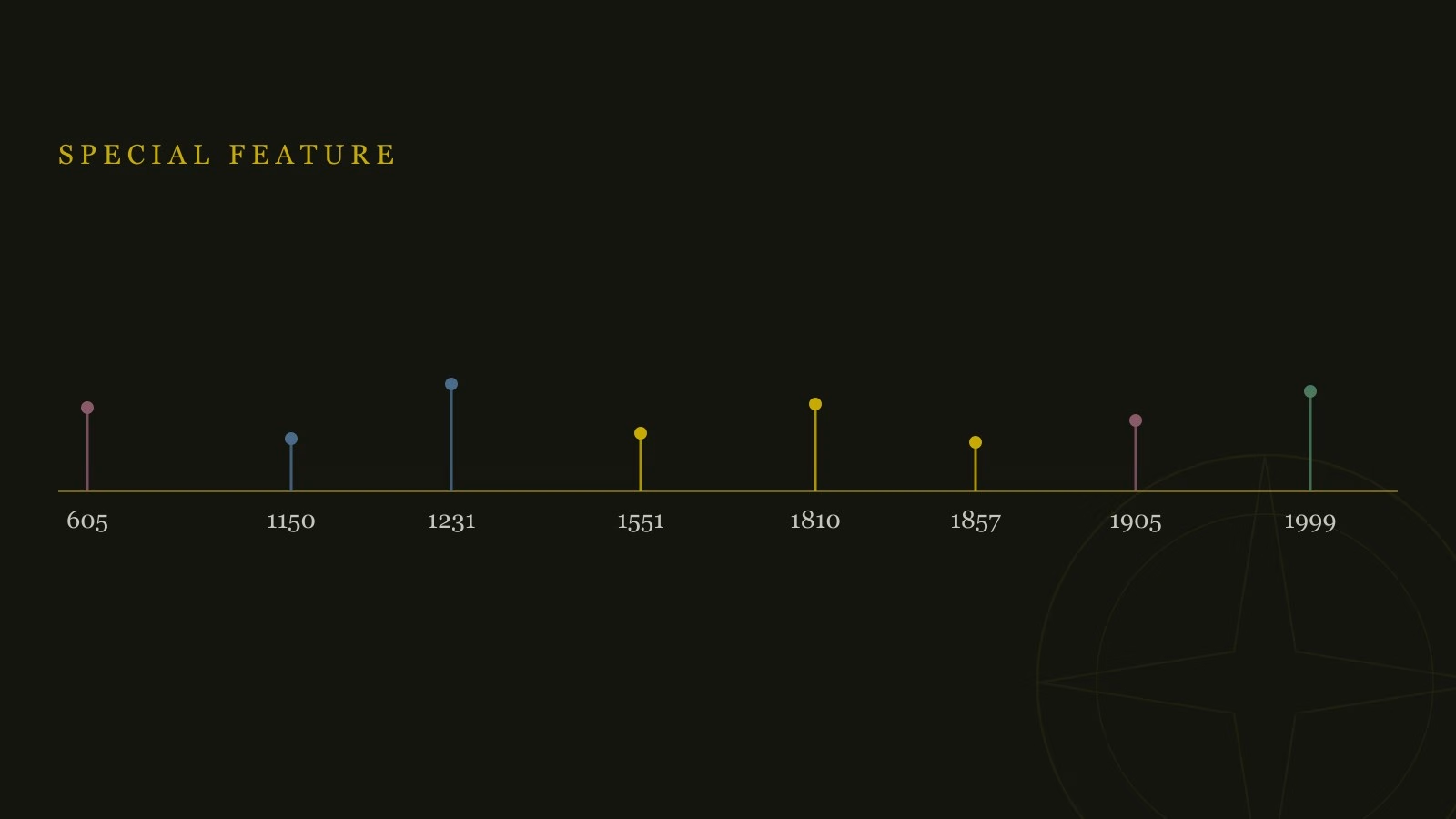
Eight hundred years ago a body of teachers in Paris began certifying who was fit to practise. The system they invented now decides which doors open in almost every country on earth, and it does not work the way most families assume.
Every credential is an answer to the same question: how does a stranger know what you can do? Families deciding between schools, countries and qualifications are rarely asked to think about that question directly, and yet it governs everything. The value of a qualification depends entirely on whose trust it is designed to earn, and on how far that trust carries. Eight hundred years of history turn out to be unusually practical on this point.
01
The University Began as a Guild
The word university comes from universitas, which in medieval Latin meant a corporation or guild. It described the people, not the place. A university was an association of masters and scholars with the legal standing to govern its own membership, in the same way that a guild of goldsmiths or weavers governed theirs.
This is not an etymological curiosity. It determined what a degree was. The earliest qualification was the licentia docendi, the licence to teach, and the University of Paris is generally credited with awarding the first around 1150. The holder had been examined by the existing masters and admitted to their number. What they received was permission to practise the craft.
The structure followed the trades exactly. An apprenticeship in a medieval craft ran seven years, and so did the term of study before a scholar could be admitted to the guild of Masters of Arts. The bachelor was the apprentice, still under supervision. The master had completed the training and could take pupils of his own. The doctorate was the master craftsman’s standing, and doctoral training was understood as an apprenticeship to a guild.
Two things follow from this that still shape how qualifications behave. The first is that a degree was never designed to measure how much someone knew. It certified that a body of practitioners had examined a candidate and were willing to vouch for them. The judgement was collective and professional, and the credential was the record of it.
The second is that the authority to award it was always contested. In Paris the licence could be granted only by the Chancellor of Notre Dame or the Chancellor of Sainte-Geneviève, which meant the church controlled entry to a guild that wanted to control itself. Much of the early history of the university is a running argument about who holds the right to certify, and that argument has never entirely finished.
Much of the early history of the university is a running argument about who holds the right to certify.
02
The Invention That Mattered
A local licence is of limited use. It works where the masters who issued it are known, and it stops at the city wall. The change that made academic credentials into something historically significant was the decision to make them travel.
In 1231 Pope Gregory IX granted the masters of Paris the licentia ubique docendi, the licence to teach everywhere. Toulouse received a comparable privilege two years later. The effect was to convert a local guild membership into a qualification that other institutions were obliged to honour, in places where nobody had met the holder and nobody could examine the claim.
This is the origin of the portable credential, and it solved a problem that had no other solution at the time. There was no way to verify a stranger’s competence at a distance. There were no references that could be checked, no registries, no reliable correspondence. A charter from a recognised authority was the only mechanism by which trust could be transmitted between people who would never meet.
The mechanism worked because the authority granting it was universal in the world those scholars occupied. A papal or imperial charter carried across every jurisdiction that recognised the papacy or the empire. The credential was portable precisely to the extent that the institution behind it was.
That relationship still holds. A qualification travels as far as the reputation of whoever issued it, and no further. Every modern arrangement described in this article is an attempt to extend that reach by agreement, now that there is no single authority whose word is accepted everywhere.
It also explains why scholars moved so freely. Oxford grew substantially after English scholars left Paris in 1167. Cambridge began in 1209 when a body of scholars seceded from Oxford after a dispute with the townspeople. Universities propagated by argument and departure, and the qualifications people carried with them made those departures survivable.
03
The Older Tradition
The European story is not the only one, and on the specific question of examination it is not the first. China selected officials by competitive written examination for roughly thirteen centuries. The keju system began under the Sui dynasty, between 581 and 618, when candidates started to be chosen through subject-based tests instead of birth or recommendation alone. It was abolished in 1905.
The principle was radical and remains so: that a place in the administration of a state should be allocated by demonstrated performance on a standard test, open in principle to candidates without family standing. Korea and Vietnam adopted versions of it. The examinations shaped a civilisation’s understanding of what merit was and how it should be recognised, and the modern gaokao is a direct descendant.
The connection to the West is documented and often left out. Jesuit missionaries brought detailed accounts of the Chinese examinations to European readers from the late sixteenth century. By the nineteenth century the idea of competitive examination for public office was openly associated with China in British periodicals and parliamentary debate, and the association was not disputed by those making the case.
It reached British practice through the empire. Competitive examination was adopted for the Indian Civil Service, and the Northcote-Trevelyan Report of 1854 recommended the same approach for the civil service at home, which followed in 1855. A recruitment method developed in Sui and Tang China became the standard by which Britain, and subsequently much of the world, decided who could hold public office.
The significance for this article is that two entirely separate traditions arrived at credentials for the same underlying reason. One began with a guild licensing its own members. The other began with a state trying to staff itself without relying on the recommendations of powerful families. Both were solving the problem of how to trust someone you do not know, and both settled on an examined, certified, transferable claim.
Two separate traditions arrived at credentials for the same reason: how to trust someone you do not know.
04
How the Model Travelled
Universities spread across the world by four distinct mechanisms, and the differences between them still show in how qualifications behave in each region.
The first was migration, described above, which carried the model across Europe through secession and dispute. The second was charter, the granting of degree-awarding authority by pope or emperor, which is the ancestor of every accreditation system now in use. A modern national qualifications framework does what a papal bull once did: it declares whose certificates count.
The third was empire, and it moved fastest. Spanish authorities chartered a university at Santo Domingo in 1538 and one at Lima in 1551, the latter still operating continuously today, with Mexico following in the same year. These institutions predate Harvard, founded in 1636, by roughly a century. Higher education in the Americas is usually said to begin in New England, which is a matter of which histories get retold.
Britain exported its model later and more systematically. The universities of Calcutta, Bombay and Madras were established in 1857 on the recommendations of Wood’s Despatch, and were modelled on the University of London. What repays attention is that they began largely as examining bodies. They did not teach. They set examinations, assessed candidates and conferred degrees, and colleges elsewhere did the instruction.
That is the clearest illustration of the argument in this article. What the empire found worth exporting was the certifying function on its own, separated from the education it was supposed to summarise, because certification was the part that solved an administrative problem. A colonial service needed a reliable way to identify who could be employed, and an examining university produced exactly that.
The fourth mechanism was deliberate adoption, and it is the most interesting because nobody was compelled. When Wilhelm von Humboldt founded the University of Berlin in 1810, he built it on the unity of teaching and research, academic freedom, and the ideal of Bildung. The model produced the modern doctorate and the research university as an institution.
Two countries then chose it. Johns Hopkins opened in 1876 as the first American university to organise itself around research on the German model. The University of Tokyo was established in 1877, as Meiji Japan set about adopting Western learning to build a modern state, and looked principally to German and Prussian models in doing so. Neither the United States nor Japan was colonised into the decision. Both surveyed the available systems and selected the same one.
05
The Machinery of Recognition
Once the papacy no longer supplied a universal authority, portability had to be manufactured by treaty. Most families never encounter this machinery directly, and it determines whether a qualification functions abroad.
The Lisbon Recognition Convention, adopted in 1997 by the Council of Europe and UNESCO, established the principle that a qualification from one signatory should be recognised by another unless a substantial difference can be demonstrated. The burden of proof sits with the institution refusing recognition. As of July 2025 it had fifty-seven contracting parties.
The Bologna Declaration followed on 19 June 1999, signed by the education ministers of twenty-nine European countries. It committed them to a common three-cycle structure of bachelor, master and doctorate, to a shared credit system in ECTS, and to cooperation on quality assurance. Undergraduate degrees were set at 180 to 240 credits and master’s degrees at 60 to 120. The European Higher Education Area it created has since grown well beyond its original signatories.
Notice where it was signed. The countries of Europe met in Bologna, at the oldest university on the continent, to agree that their qualifications should mean the same thing in each other’s countries. The problem the papal charter solved in 1231 had come back, and answering it now takes a convention, a credit system and the assent of dozens of governments.
Professional recognition developed on a separate track. Engineering bodies established mutual recognition of accredited degrees through the Washington Accord, and comparable arrangements exist in medicine, accountancy and architecture. These matter more than academic recognition for anyone intending to practise, because a degree that is academically recognised may still leave its holder unable to work.
Most recently, UNESCO’s Global Convention on the Recognition of Qualifications concerning Higher Education was adopted in November 2019 and entered into force on 5 March 2023. It is the first United Nations treaty on higher education with truly global scope. Whether it delivers in practice will depend on ratification, and the ambition is the point: an attempt to restore, by agreement among states, the universal recognition that a single authority once conferred.
The problem the papal charter solved in 1231 now requires pages of treaty language and the signatures of sovereign states.
Also in this pillar
Study Abroad vs. Staying Local: Which Path Actually Fits Your Career Goals
06
The Alternatives That Stayed Home
The international story is only half of it. Several countries developed credentials that never joined the common framework, and some of them carry more weight at home than any university degree.
France built an elite track outside the university system entirely. The grandes écoles, of which the École Polytechnique was founded in 1794 and later militarised under Napoleon, select by competitive examination after intensive preparatory classes. The hierarchy among them is unofficial and understood in precise detail by French employers. A graduate of a leading grande école occupies a position in French professional life that a university degree does not confer, and the distinction is largely invisible to foreign employers reading a curriculum vitae.
Germany and Switzerland built something different again. Around two thirds of young people in Switzerland enter vocational education after compulsory schooling, combining employment with classroom instruction and earning a Federal VET Certificate after two years or a Federal VET Diploma after three or four. It is the mainstream path, it carries genuine standing among employers and families alike, and it feeds a professional education system that reaches to the top of Swiss industry.
Germany also retains the Staatsexamen. Lawyers, doctors and teachers qualify through a state examination, not a university degree, which places the certifying authority with the state and keeps it there. The medieval argument over who holds the right to certify was settled differently in Germany than in Britain, and the consequence persists.
Britain and the Commonwealth kept the guilds themselves. Chartered status through a professional body, in accountancy, surveying, engineering and elsewhere, is a credential in the original sense: a body of practitioners examining a candidate and admitting them to membership. In several fields it outranks any academic qualification, and it is the closest surviving relative of the licentia docendi.
China, meanwhile, retained the examination. The gaokao allocates university places by performance on a single national test, which is recognisably the keju principle operating at national scale, thirteen centuries after it began.
The pattern across all of these is that each country resolved the question of who certifies in its own way, and the answers hardened. A family assessing an unfamiliar system should ask who does the examining and who accepts the result, because those two answers describe the credential more accurately than its name does.
07
Portability Against Prestige
Put the two halves together and the result is uncomfortable. The most valuable credential in a country is frequently the one that travels worst.
A place at a leading grande école, a Swiss federal diploma with the professional education that follows it, chartered status in a British profession: each is enormously valuable where it is understood, and each becomes difficult to read the moment it crosses a border. Meanwhile the most portable qualifications, structured to be legible everywhere under the Bologna framework, are legible precisely because they have been standardised, and standardisation removes the local distinctions that carry prestige.
Economics explains the mechanism. Michael Spence’s work on job market signalling, published in 1973 and recognised with a Nobel prize in 2001, showed that a qualification can carry information even when the education itself adds nothing directly useful, provided it is harder to obtain for those less suited to the work. The signal lies in the difficulty, and the difficulty has to be visible to whoever is reading it. A signal nobody can interpret conveys nothing at all.
This is why prestige concentrates in opaque fields. Where the quality of work is hard for an outsider to assess, an employer leans heavily on the institution’s name, because it is the only evidence available before hiring. Where the work speaks plainly for itself, in the form of a portfolio, a repository of code, a record of cases or sales, the name of the institution fades quickly and often disappears within a few years.
For a family, this converts an abstract question into a practical one. The choice between a prestigious local path and a portable international one is not a choice about quality. It is a decision about which audience the qualification needs to persuade, and for how long. A credential optimised for a domestic elite and one optimised for global mobility are solving different problems, and the more decisively one is chosen, the less well it serves the other.
This trade-off cannot be avoided, only made deliberately. Families who do it well decide early which audience they are addressing, and accept the cost of that choice with their eyes open.
The most valuable credential in a country is frequently the one that travels worst.
Questions This Raises
Does the prestige of a university still matter as much as it used to?
It matters enormously in some fields and very little in others, and the distinguishing factor is how easily an outsider can judge the work. Where quality is hard to observe before hiring, the institution carries the signal. Where the output is directly inspectable, the institution’s name fades within a few years of graduation. Assess the field before assessing the university.
Is a vocational qualification a lesser credential?
Not in the systems built around them. Around two thirds of Swiss young people enter vocational training, and it leads to senior professional standing rather than away from it. The relevant question is whether the qualification is respected by the people who will decide the holder’s career, and in Switzerland, Germany and Austria the answer for these routes is unambiguous.
Why do some qualifications fail to be recognised abroad?
Recognition is granted by agreement, not by merit. The Lisbon Recognition Convention and the Bologna framework created machinery for it across Europe, and UNESCO’s global convention extends the principle further. Outside those arrangements, recognition depends on bilateral agreements and on the judgement of individual institutions, which is why qualifications of equivalent standard can be treated very differently.
What is the difference between academic and professional recognition?
Academic recognition allows a qualification to count towards further study. Professional recognition permits practice. They are granted by different bodies under different agreements, and the second is frequently the harder to obtain. Anyone intending to practise medicine, law, engineering, architecture or accountancy in another country should confirm the professional position before the academic one.
How should a family weigh a local elite path against studying abroad?
By deciding which audience the qualification needs to persuade. A credential built for a domestic elite and one built for international mobility solve different problems, and excelling at one generally means performing less well at the other. The decision is more tractable once it is framed that way, because it turns on intended destination rather than on any ranking of quality.
None of this history is decorative. A credential is a claim about a person, addressed to someone who cannot verify it directly, and backed by an institution the reader is willing to trust. That has been true since a body of masters in Paris agreed to vouch for one another, and every development since has been an argument about how far such a claim should carry and who is entitled to make it.
Which means the question worth asking about any qualification is not how good it is. It is who issued it, who accepts it, and how far from home that acceptance extends. Those three answers describe what a credential will do for the person holding it, and they are knowable in advance.
Where to Go From Here
-

The AI-Era Subject Selection Checklist
Ruling out a subject because of AI headlines is usually the wrong move. Here’s how to research how a field…
-

A Practical Guide to Exploring Careers Before You Have to Choose One
You don’t need to pick a career at 16, but you do need real exposure to more than the handful…
-

What Is an Aptitude Test?
An aptitude test measures how you reason, not what you already know, and it isn’t the pass/fail exam it’s sometimes…
-

Should I Still Study a Field AI Is Reshaping?
Fields that are changing aren’t the same as fields that are disappearing. Here’s how to think about studying a field…
-

A Parent’s Guide to Sending Your Child Abroad
Sending your child abroad to study is a proud and anxious thing at once. This is a guide to helping…
-

Gap Year vs. Straight Through: Which Timing Fits You?
A gap year’s value depends entirely on structure, an unstructured year and a deliberately planned one produce very different outcomes.…